
On August 5, 2025, Anthropic publicly released Claude Opus 4.1, a significant refinement of its flagship Opus 4 model family, aimed at advancing agentic tasks, real-world software engineering, and complex reasoning. This incremental update, which builds on the May debut of Claude Opus 4, delivers higher accuracy on coding benchmarks, extended context handling, and maintains the company’s stringent AI safety standards.
Performance Enhancements
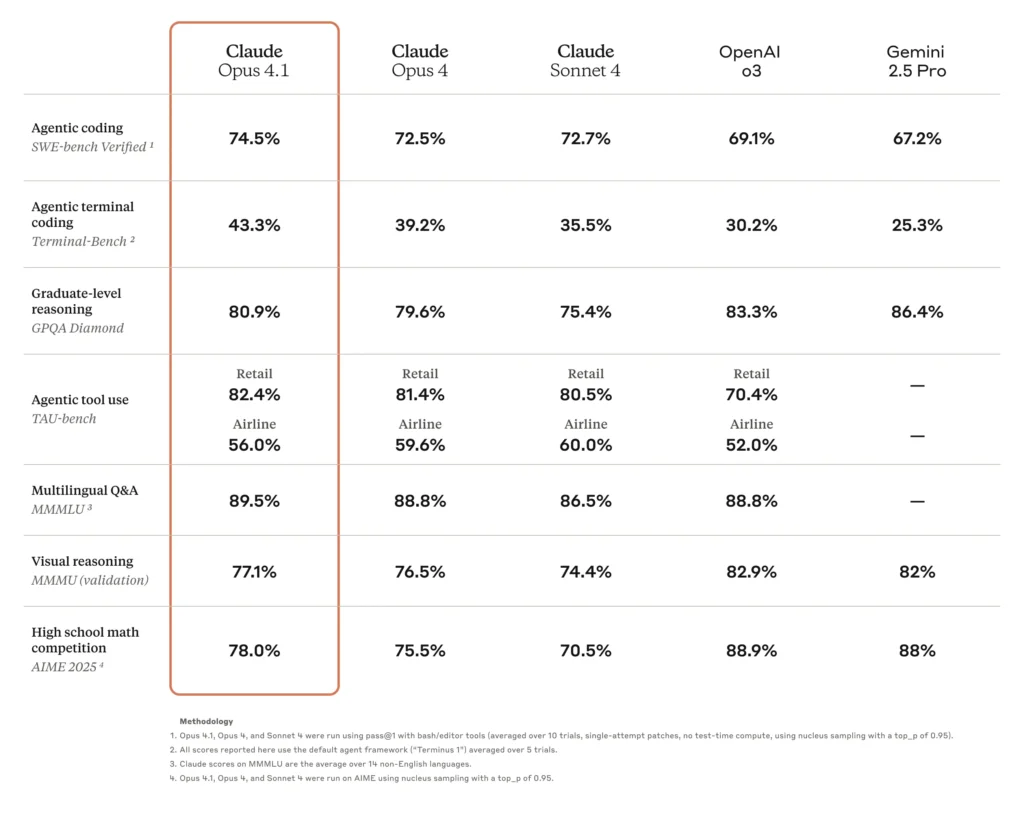
Benchmarking data highlights notable gains over Opus 4. On the SWE-bench Verified coding evaluation, Claude Opus 4.1 achieves a 74.5% accuracy, reflecting a 2-point increase from Opus 4’s 72.5% and a substantial jump from Sonnet 3.7’s 62.3% . These gains are especially pronounced in multi-file code refactoring, debugging large codebases, and maintaining stylistic consistency across extended code outputs—enabled in part by the model’s expanded context window for up to 32,000 output tokens, which supports complex, multi-step code generation and transformations .
Robust Context Window and Pricing
Maintaining the same pricing tiers as Opus 4, Claude Opus 4.1 supports up to 64,000 tokens of context, enabling it to tackle extensive codebases and “extended thinking” prompts without sacrificing coherence or performance. This high token capacity underpins more thorough code reviews, detailed technical analyses, and complex multi-turn dialogues.
Commitment to Safety and Transparency
Anthropic’s release is accompanied by a System Card Addendum detailing targeted safety evaluations for Opus 4.1. Single-turn tests show an improved harmless response rate of 98.76% against policy-violating prompts, versus 97.27% for Opus 4, confirming that the model more reliably refuses inappropriate requests. Child safety, bias, and cybersecurity assessments remain consistent with previous rigorous standards, reflecting Anthropic’s ongoing transparency and safeguards.
Positioning Amid Intensifying Competition
The launch of Claude Opus 4.1 coincides with rival OpenAI’s teasers about GPT-5, marking a critical juncture in the AI race. Industry observers note that Anthropic’s focus on developer productivity—evident in enterprise partnerships with Windsurf (soon to be part of Cognition) and Japan’s Rakuten Group—underscores the strategic value of high-precision coding assistants. As enterprises continue to adopt AI-driven development tools, Claude Opus 4.1 aims to reinforce Anthropic’s leadership in safety-conscious, agentic AI.
Getting Started
CometAPI is a unified API platform that aggregates over 500 AI models from leading providers—such as OpenAI’s GPT series, Google’s Gemini, Anthropic’s Claude, Midjourney, Suno, and more—into a single, developer-friendly interface. By offering consistent authentication, request formatting, and response handling, CometAPI dramatically simplifies the integration of AI capabilities into your applications. Whether you’re building chatbots, image generators, music composers, or data‐driven analytics pipelines, CometAPI lets you iterate faster, control costs, and remain vendor-agnostic—all while tapping into the latest breakthroughs across the AI ecosystem.
Developers can access Claude Opus 4.1 through CometAPI, the latest models version listed are as of the article’s publication date. To begin, explore the model’s capabilities in the Playground and consult the API guide for detailed instructions. Before accessing, please make sure you have logged in to CometAPI and obtained the API key. CometAPI offer a price far lower than the official price to help you integrate.