
Stable Diffusion has rapidly become one of the most influential text-to-image generative AI models, offering users unprecedented creative freedom. At its core, Stability AI provides its “Core Models,” including Stable Diffusion 3 2B, free of charge for all users, subject to licensing terms that differ for non-commercial versus commercial applications. Individuals can self-host and run the model locally with no licensing fees, and organizations with annual revenues under USD 1 million may also leverage the models commercially at no cost. However, businesses exceeding this threshold must secure an enterprise license. Recent developments—including expanded cloud partnerships, deprecation of older APIs, and regulatory scrutiny over misuse—underscore the evolving landscape around what “free” truly means when balancing accessibility, sustainability, and ethical considerations.
What is Stable Diffusion and where does it originate?
Origins and public release
Stable Diffusion was publicly released on August 22, 2022 by Stability AI in collaboration with researchers at the Ludwig Maximilian University of Munich and EleutherAI.
The model immediately attracted widespread attention for its ability to generate high‑quality images from text prompts while being open‑source, unlike many proprietary alternatives .
Technical foundations
At its core, Stable Diffusion employs a latent diffusion approach, wherein images are iteratively “denoised” in a compressed latent space, yielding detailed outputs with greater computational efficiency than pixel‑space diffusion methods.
Weights for the model have continued to be hosted on platforms like Hugging Face, enabling self‑hosting and integration into a variety of applications.
Can individuals use Stable Diffusion for free?
Community License terms
In July 2024, Stability AI introduced a new Community License that made Stable Diffusion free for research, non‑commercial, and commercial use for entities with annual revenues under USD 1 million .
Under this license, users can fine‑tune, derive new works (e.g., LoRAs and hypernetworks), and distribute outputs without cost, provided they comply with the Acceptable Use Policy.
Self-hosting and non-commercial use:
Individuals can download and run Stable Diffusion locally on personal hardware without paying any license fees. This self-hosted approach ensures privacy, offline generation, and no usage limits beyond one’s compute capacity. Numerous open-source repositories and community projects on GitHub offer pre-trained weights and easy-to-follow instructions, reinforcing the model’s free accessibility for personal, educational, and research use .
API access and developer considerations:
Beyond self-hosting, Stability AI provides API access to Stable Diffusion 3 and 3.5 through its developer platform. As of April 17, 2025, the APIs for Stable Diffusion 3.0 were deprecated and users were automatically migrated to the Stable Diffusion 3.5 APIs at no extra cost, ensuring continued free access to the latest models for existing developers. For non-commercial projects, individuals and organizations can call the API without charges, making it convenient for prototyping, experimentation, and integration into apps. However, API usage may be subject to rate limits and fair-use policies to maintain service quality.
How has the licensing of Stable Diffusion evolved over time?
Initial release licensing
The original Stable Diffusion v1.0 release in August 2022 came with a research‑only license, intended primarily for academic and non‑commercial experimentation .
Early adopters were required to agree to restrictions preventing creation of competing “foundational models” directly from Stable Diffusion’s core weights .
Introduction of the Community License
By July 2024, following community feedback, Stability AI revamped its license to permit broader commercial use under the Community License, lowering barriers for startups and developers earning under USD 1 million.
This change was applauded for aligning more closely with open‑source principles and creator freedoms, while still safeguarding the company’s investment .
Stable Diffusion 3.5 license adjustments
In November 2024, Stable Diffusion 3.5 was released under the same Community License, solidifying free usage for most users and streamlining terms across versions.
This release emphasized distribution and monetization rights, encouraging fine‑tuning, LoRA creation, and integration into commercial applications under the established revenue threshold .
Where can you access Stable Diffusion for free?
Self‑hosting and open‑source platforms
Anyone can download the Stable Diffusion model weights from repositories such as Hugging Face and deploy them locally or on custom servers, enabling offline and privacy‑focused usage without cost .
Self‑hosting requires moderate technical expertise—installation involves setting up a Python environment and satisfying GPU dependencies—but communities have published detailed guides to simplify this process .
DreamStudio Lite and free tiers
Stability AI’s DreamStudio platform offers a “Lite” tier where users can generate images for free up to a monthly credit limit, ideal for casual experimentation without local setup .
The DreamStudio Beta now even supports Stable Diffusion 3.5 and advanced editing tools like Inpaint and Resize within its free allocation, with paid plans available for higher-volume needs.
CometAPI
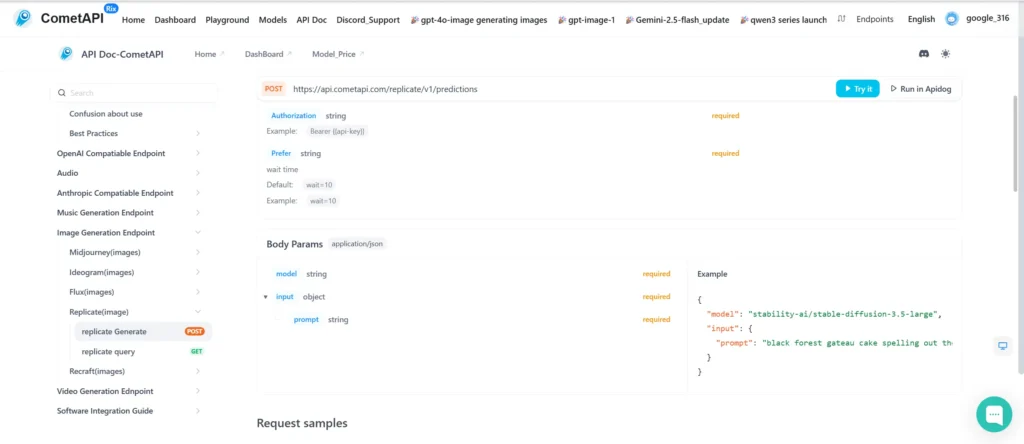
CometAPI provides a unified REST interface that aggregates hundreds of AI models—including Google’s Gemini family—under a consistent endpoint, with built-in API-key management, usage quotas, and billing dashboards. Instead of juggling multiple vendor URLs and credentials, you point your client at https://api.cometapi.com/v1 and specify the target model in each request.
Developers can access Stable Diffusion API (Stable Diffusion 3.5 Large API etc) through CometAPI.
What are the limitations of the free usage?
Revenue‑based licensing threshold
Entities exceeding USD 1 million in yearly revenue must obtain an Enterprise license to use the Stable Diffusion core models commercially, ensuring larger businesses contribute to continued model development .
This provision is enforced via the license’s revocability clause—Stability AI can revoke license rights if terms are violated, although outputs already generated remain owned by the user.
Even under the Community License, users must adhere to Stability AI’s Acceptable Use Policy, which prohibits generation of harmful or illegal content and implements safety filters in hosted services .
Recent updates to the license and model releases have included improved moderation tools and watermarking options to combat misuse and intellectual property disputes .
How does the OpenRAIL license define usage terms?
Early versions of Stable Diffusion were released under the CreativeML OpenRAIL-M license, a permissive license focusing on ethical and legal use. Under OpenRAIL, the model can be used for commercial and non-commercial purposes, provided downstream users adhere to the license’s responsibility and distribution requirements. Despite its permissiveness, OpenRAIL explicitly differs from OSI-approved open-source licenses, as it imposes usage restrictions to deter malicious applications like deepfakes and non-consensual imagery .
How does Stable Diffusion compare to other AI image generators in terms of cost?
Proprietary AI image generators—such as those offered by OpenAI, Midjourney, and Anthropic—often charge per image or through subscription tiers, with prices ranging from cents to dollars per generation. These costs can become prohibitive for high-volume or low-margin use cases. In contrast, Stable Diffusion’s licensing model allows organizations under the revenue threshold to generate unlimited images without licensing fees, offering a compelling value proposition for startups and individual entrepreneurs.
Comparison with Midjourney
In a head‑to‑head comparison, Stable Diffusion offers a fully free open‑source version, whereas Midjourney lacks a free tier beyond a limited trial, making Stable Diffusion more cost‑effective for budget‑conscious users .
Midjourney’s subscription plans start at USD 10 monthly without open‑source weights, while Stable Diffusion’s local and hosted free options provide unparalleled flexibility .
Comparison with DALL·E 3
DALL·E 3, accessible via OpenAI’s API or ChatGPT Plus subscription, costs USD 20 per month for API access, with usage‑based credit fees, whereas Stable Diffusion remains free under open‑source licensing for most use cases .
However, DALL·E 3 offers integrated safety guardrails and a user‑friendly interface, which can justify its cost for organizations prioritizing turnkey solutions over self‑hosting.
What is the future outlook for Stable Diffusion’s pricing and licensing?
Upcoming developments
Stability AI continues to expand its ecosystem, most recently optimizing Stable Diffusion for AMD Radeon GPUs and Ryzen AI APUs, which may lower hardware costs for self‑hosters .
Collaborations such as the joint release of Stable Audio Open Small suggest Stability AI’s commitment to broadening free and open‑source offerings across modalities.
Impact on the AI ecosystem
By maintaining a generous free tier and community license, Stable Diffusion is driving innovation in generative art, research, and commercial creativity, while prompting competitors to reconsider their pricing models .
The balance between open‑source access and sustainable enterprise licensing could serve as a blueprint for other AI providers aiming to scale responsibly.
Through its evolving licensing strategy—from research‑only beginnings to today’s flexible Community License—Stable Diffusion has democratized image generation while providing clear pathways for enterprise engagement. Whether you choose to self‑host the model, leverage DreamStudio’s free tier, or opt for a paid plan, you can harness the power of generative AI without upfront costs, so long as your usage aligns with Stability AI’s licensing terms and revenue thresholds.
Get Started
CometAPI provides a unified REST interface that aggregates hundreds of AI models—under a consistent endpoint, with built-in API-key management, usage quotas, and billing dashboards.
More details about Stable-Diffusion XL 1.0 API and Stable Diffusion 3.5 Large API etc,For more Model information in Comet API please see API doc.Price in CometAPI:
- stability-ai/stable-diffusion-3.5-large: $0.208 per create API call.
- stability-ai/stable-diffusion-3.5-medium: $0.112 per call.
- stability-ai/stable-diffusion-3.5-large-turbo: $0.128 per create API call.
- stability-ai/stable-diffusion-3: $0.112 per call
- stability-ai/stable-diffusion: $0.016 per call
This pricing structure allows developers to scale their projects efficiently without overspending.
To begin, explore the model’s capabilities in the Playground and consult the API guide for detailed instructions.
See Also Does Stable Diffusion Allow NSFW