
In May 2025, Anthropic unveiled Claude Sonnet 4 alongside its sibling model Claude Opus 4, marking a major milestone in the evolution of the Claude family of large language models. Building on the strengths of its predecessor, Claude Sonnet 3.7, Sonnet 4 introduces a suite of enhancements targeting reasoning depth, coding proficiency, and seamless tool integration. By balancing high performance with practical efficiency, Sonnet 4 aims to serve a broad spectrum of users—from individual developers and research teams to enterprise customers requiring reliable AI assistants for complex, high-volume tasks. This article synthesizes the latest announcements, system card disclosures, and third-party analyses to provide a comprehensive overview of “What is Claude Sonnet 4?” .
What is Claude Sonnet 4?
Claude Sonnet 4 is the newest iteration of Anthropic’s “Sonnet”‐tier model, designed as a versatile, general‐purpose AI assistant that offers both standard and hybrid reasoning modes. As the successor to Claude Sonnet 3.7, it delivers enhanced coding, complex‐problem solving, and precision in responses, all while maintaining cost‐efficiency for a broad range of tasks.
Origin and Naming
The “Claude” series, named in homage to information‐theory pioneer Claude Shannon, reflects Anthropic’s focus on transparency, safety, and ethical AI development. Within this series, “Sonnet” models have historically provided a balance: more capable than the faster, lighter “Haiku” models, yet more cost‐effective and efficient than the most powerful “Opus” variants .
Core Capabilities
- Hybrid Reasoning: Users can toggle between a default “fast” mode for rapid responses and an “extended thinking” mode that devotes more compute to multi‐step reasoning and tool usage.
- Enhanced Coding Support: Sonnet 4 exhibits improved performance on coding tasks, from autocompleting lines of code to debugging complex algorithms.
- Long‐Context Understanding: With support for tens of thousands of tokens (and up to 1 million tokens in enterprise deployments), it can analyze and generate responses for lengthy documents, contracts, or datasets.
- Safety and Alignment: Built under Anthropic’s Constitutional AI framework, Sonnet 4 is designed to minimize harmful outputs and adhere to ethical guidelines, reducing shortcut reasoning by approximately 65% compared to prior models.
How does Claude Sonnet 4 stand out within the Claude 4 family?
Within the Claude 4 lineup—which includes Haiku (fastest), Sonnet (balanced), and Opus (most powerful)—Sonnet 4 targets users who require a robust mix of capability and efficiency without the premium cost of the Opus tier.
Hybrid Modes: Speed vs. Depth
- Standard Mode: Prioritizes latency, ideal for chatbots, drafting emails, or summarizing text.
- Extended Thinking Mode: Allocates more compute to internal reasoning steps, summarizing longer “thought” chains for transparency. Notably, only ~5% of extended thinking chains exceed the summarization threshold, ensuring concise insights most of the time.
Efficiency and Cost-Effectiveness
- Token Pricing: Priced at $3 per million input tokens and $15 per million output tokens, Sonnet 4 offers roughly one‐fifth the cost of Opus 4 while delivering enhanced reasoning over Sonnet 3.7 .
- Resource Footprint: Optimized for CPU inference, enabling deployment in environments where GPU resources are limited or costly.
Integrated Tool Use and Parallel Execution
Another major enhancement is Sonnet 4’s ability to interleave its internal reasoning with external tool invocations—such as web search, code execution environments, or proprietary databases—within a single query. This “extended thinking with tool use” feature allows simultaneous execution of multiple tools, enabling complex workflows like fact-checking against live data sources, fetching external documents, or orchestrating API calls. Developers report that tooling integration has become up to 220% more reliable compared to Sonnet 3.7, significantly boosting practical utility for automated coding and data analysis tasks .
Memory and Context Window Enhancements
Sonnet 4 inherits an expanded context window that can handle hundreds of thousands of tokens in enterprise deployments—facilitating the analysis of lengthy documents, multimodal inputs, and multi-turn conversations without losing coherence. Additionally, Sonnet 4 features improved “short-term memory” for the duration of a session, retaining critical details across exchanges and enabling smoother interactions. These memory improvements are particularly valuable for use cases requiring continuity, such as drafting research papers, conducting legal analysis, or managing customer support dialogues .
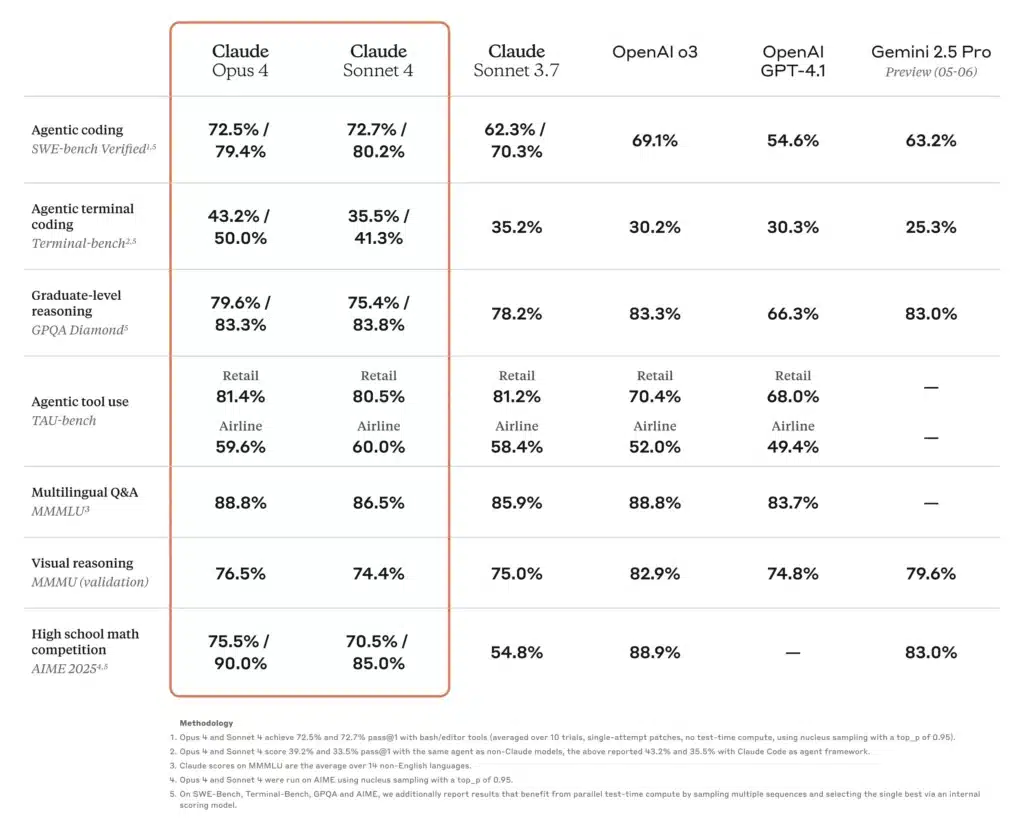
What benchmarks demonstrate Claude Sonnet 4’s performance?
Anthropic has subjected Sonnet 4 to a battery of public and internal evaluations, showcasing its strength in both capability and safety.
Coding and Reasoning Benchmarks
- MBPP (Python Code Generation): Sonnet 4 achieves pass rates substantially higher than Sonnet 3.7 on the “hard” problem set (0.824 vs. ~0.75), demonstrating its improved algorithmic reasoning .
- BIG-Bench Hard: On complex linguistic tasks requiring logic and world knowledge, Sonnet 4 scores above 0.82, outperforming its predecessor by over 4% and narrowing the gap with Opus 4 .
Safety and Alignment Evaluations
- Bias Benchmark for Question Answering (BBQ): Sonnet 4 records a bias score of 0.61% (vs. 0.21% for Opus 4) with 99.4% accuracy, reflecting strong mitigation of discriminatory responses .
- Cybersecurity Suite: In specialized “cyber‐harness” and “crypto” tests, Sonnet 4 matches or exceeds Sonnet 3.7’s performance, demonstrating its ability to reason about network security and cryptographic protocols without engaging in harmful behaviour.
How can users access Claude Sonnet 4?
Anthropic and its cloud partners have made Claude Sonnet 4 widely available through multiple channels, catering to both free‐tier users and enterprise customers.
Access Channels
- Anthropic API: Direct API access with RESTful endpoints, supporting JSON payloads and streaming responses.
- Claude.ai Interface: A web‐based playground offering chat UI, document summarization, and code editing. Free users receive access to Sonnet 4 (with rate limits), while paid tiers unlock extended thinking and Opus 4.
- Amazon Bedrock: Available as part of Amazon’s managed Foundation Models service, enabling integration with AWS services such as Lambda and SageMaker .
- Google Cloud Vertex AI: Sonnet 4 can be invoked via Vertex’s unified API, integrating with Google Cloud storage and data analytics pipelines .
- GitHub Copilot: Now in public preview, Sonnet 4 powers Copilot suggestions for code completion and in-editor research, succeeding Sonnet 3.7 and offering a balanced mix of capability and speed .
- CometAPI: CometAPI provides a unified REST interface that aggregates hundreds of AI models—under a consistent endpoint, with built-in API-key management, usage quotas, and billing dashboards. Developers can access Claude Sonnet 4 API through CometAPI.CometAPI’ve also added
cometapi-sonnet-4-20250514andcometapi-sonnet-4-20250514-thinkingspecifically for use in Cursor.
Pricing Plans
| Plan | Sonnet 4 Access | Opus 4 Access | Extended Thinking |
| Free | Standard mode, limited usage | Not included | No |
| Pro ($20/mo) | Sonnet 4 standard + extended mode | Opus 4 standard mode only | Yes |
| Team/Enterprise | Unrestricted Sonnet & Opus 4 | Enhanced SLAs, dedicated instances | Yes |
Token pricing: Sonnet 4 input at $3/million, output at $15/million; Opus 4 input at $15/million, output at $75/million.Tiered per-token billing with volume discounts; Sonnet 4 usage is available to both free and paid API subscribers (free tier limited to 5M tokens per month).
What use cases can benefit from Claude Sonnet 4?
Developer Workflows and Code Generation
Sonnet 4’s robust coding metrics make it an ideal assistant for tasks such as boilerplate generation, code refactoring, automated testing scaffolds, and inline documentation. Its extended thinking with tool use can fetch and analyze external code repositories, perform live linting, and integrate with CI/CD pipelines—streamlining development lifecycles and reducing context switching for engineers .
Content Creation and High-Context Tasks
Beyond coding, Claude Sonnet 4 excels at high-context understanding required for drafting technical reports, legal memos, and research summaries. Its large context window allows ingestion of entire documents—such as white papers or regulatory filings—followed by precise Q&A, summarization, or translation. Marketing teams can leverage Sonnet 4 to generate SEO-optimized content, while customer support can automate ticket triage and response generation with minimal oversight .
By blending cost-effective pricing, hybrid reasoning, and strong safety guarantees, Claude Sonnet 4 stands poised to serve a diverse array of users—from individual developers to large enterprises—seeking a reliable AI assistant for coding, analysis, and content creation. Its position within the Claude 4 family ensures that users can select the ideal balance of power and efficiency, while continuous updates promise that Sonnet 4 will only grow more capable in the months ahead.
Getting Started
Developers can access Claude Sonnet 4 API (model: claude-sonnet-4-20250514 ; claude-sonnet-4-20250514-thinking). To begin, explore the model’s capabilities in the Playground and consult the API guide for detailed instructions. Before accessing, please make sure you have logged in to CometAPI and obtained the API key. CometAPI’ve also added cometapi-sonnet-4-20250514 and cometapi-sonnet-4-20250514-thinking specifically for use in Cursor.
New to CometAPI? Start a free 1$ trial and unleash Sonnet 4 on your toughest tasks.
We can’t wait to see what you build. If something feels off, hit the feedback button—telling us what broke is the fastest way to make it better.