What Is Flux 3?
A New Generation of Multimodal Foundation Models
FLUX 3 is the newest frontier model developed by Black Forest Labs, the company founded by several original Stable Diffusion researchers.
Instead of treating image generation, video generation, audio understanding, and robotics as separate AI systems, FLUX 3 attempts to solve them with one shared neural representation.
Traditional diffusion models primarily learn:
- Text → Image
- Image Editing
- Image Variation
FLUX 3 instead learns:
- Image Generation
- Video Generation
- Audio Understanding
- Motion Prediction
- Temporal Consistency
- Action Prediction
- World Dynamics
This architecture moves beyond pure generative AI toward what researchers increasingly call World Models.
Technical Specifications
| Specification | Flux 3 |
|---|---|
| Developer | Black Forest Labs |
| Release | 2026 (Preview Announcement) |
| Model Type | Unified Multimodal Foundation Model |
| Architecture | Flow Matching / Multimodal Foundation Architecture |
| Input Modalities | Text, Image, Video, Audio |
| Output Modalities | Image, Video, Audio, Action Prediction |
| Training Strategy | Joint multimodal training |
| Primary Objective | World modeling |
| Image Generation | Yes |
| Video Generation | Yes |
| Audio Modeling | Yes |
| Robotics Support | Yes |
| Action Prediction | Yes |
| API Availability | Early Access |
| Open Source | No (currently) |
| Commercial API | Planned |
Features and Highlights of Flux 3
Correction: Your outline requested "Features and Highlights of Claude Sonnet 5." Since this article is about Flux 3, the appropriate section is "Features and Highlights of Flux 3."
1. Unified Multimodal Training
Rather than assembling multiple expert models, Flux 3 jointly optimizes across all supported modalities.
Benefits include:
- Shared semantic understanding
- Cross-modal reasoning
- Better consistency
- Reduced modality switching
2. World Modeling
Perhaps the largest innovation is the transition from image synthesis to world understanding.
The model attempts to learn:
- gravity
- object permanence
- collision
- temporal motion
- causality
- human movement
This makes Flux 3 suitable for robotics simulation and interactive environments.
3. Native Video Learning
Unlike many diffusion systems that extend image generation into video, Flux 3 reportedly treats video as the core learning signal.
According to Black Forest Labs:
- Video training consumes over 95% of training compute
- Temporal understanding is prioritized over static rendering
- Motion prediction improves consistency
4. Audio Integration
Flux 3 jointly learns audio rather than adding it afterward.
Potential capabilities include:
- lip synchronization
- environmental sound understanding
- multimodal reasoning
- synchronized video generation
5. Robotics-Oriented Design
The announcement highlights robotics as an important deployment target.
Potential applications:
- robot planning
- navigation
- industrial automation
- autonomous systems
6. High-Quality Image Generation
Flux 3 continues BFL's strong reputation in:
- photorealism
- typography
- prompt adherence
- lighting realism
- composition
while expanding beyond image-only tasks.
Model Versions
At launch, Black Forest Labs has introduced Flux 3 as a unified multimodal platform rather than a broad family of variants. Public information currently includes:
| Model | Status |
|---|---|
| Flux 3 | Early Access |
| Flux 3 API | Planned |
| Image Generation | Available |
| Video Generation | Preview |
| Audio Generation | Preview |
| Action Prediction | Preview |
Additional variants (such as Pro, Dev, or lightweight editions) have not yet been officially announced.
Benchmark Performance
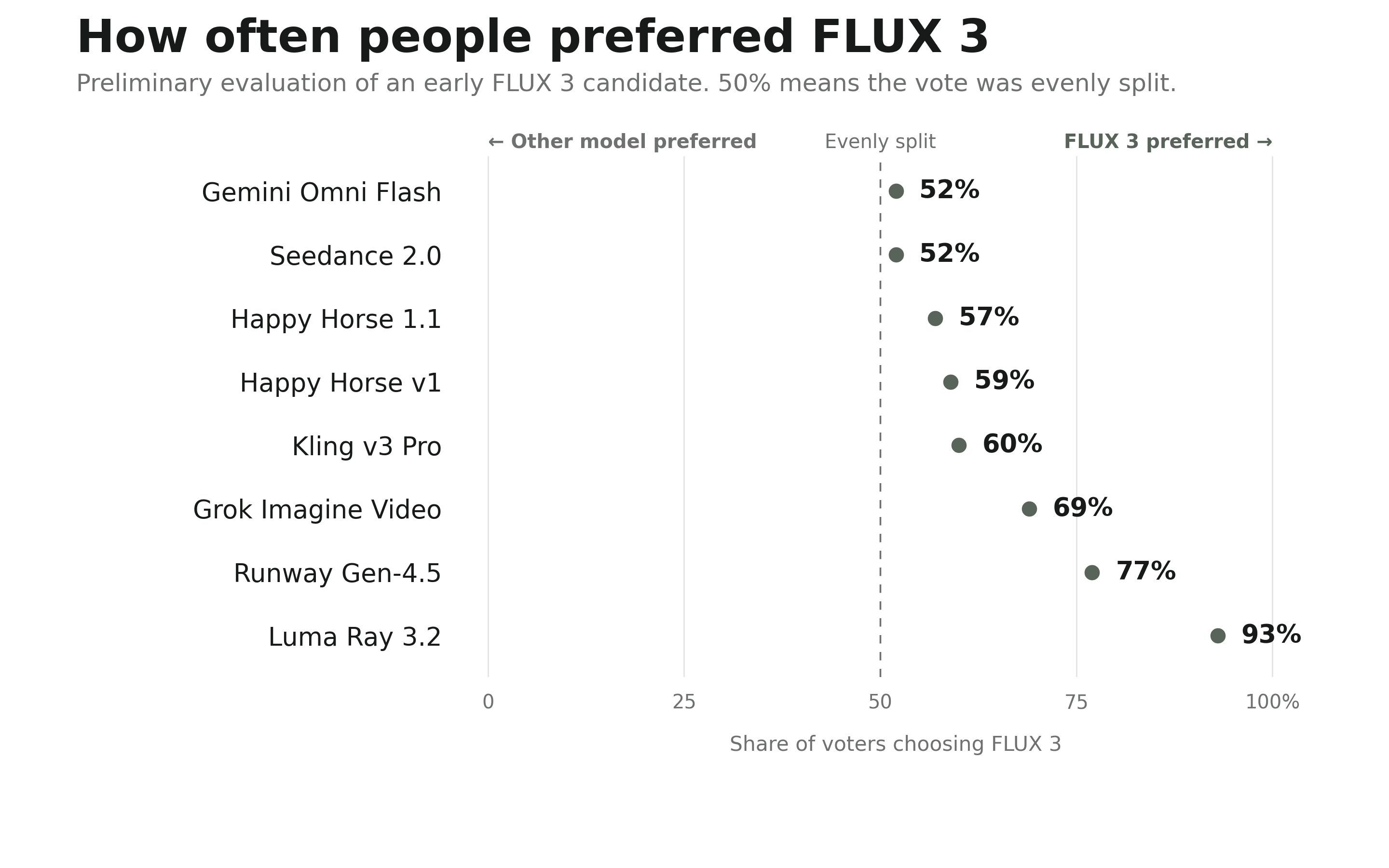
As the model and the harness around it are still in development, these results are preliminary, and we expect further improvements during the early access phase. Across early evaluations, FLUX 3 was preferred over Grok Imagine Video in up to 69% of comparisons, Kling v3 Pro in 60%, Happy Horse v1 in 59%, Happy Horse 1.1 in 57%, Seedance 2.0 and Gemini Omni Flash in 52%. FLUX 3 was preferred over Runway Gen-4.5 in 77% of comparisons and over Luma Ray 3.2 in 93% of comparisons.
Claimed strengths include:
- Superior temporal consistency
- Better physical reasoning
- Improved motion generation
- Native multimodal learning
- Robotics-oriented world modeling
Unlike traditional image benchmarks (FID, CLIPScore, GenEval), many of Flux 3's intended applications will likely require new evaluation methods focused on video coherence, multimodal alignment, and action prediction.
Limitations
Despite its impressive architecture, Flux 3 still has several limitations.
Early Access
The model is currently not generally available.
Unknown Pricing
Official API pricing has not yet been announced.
Hardware Requirements
Because the model jointly learns images, videos, audio, and action prediction, inference is expected to require substantially more compute than image-only FLUX models.
Limited Documentation
Many architectural details remain undisclosed.
How to Use Flux 3 API on CometAPI
Once Flux 3 becomes available through API providers, a unified API gateway such as CometAPI can simplify integration.
A typical workflow is:
- Register for a CometAPI account.
- Obtain an API key from the dashboard.
- Select the Flux 3 model (when available).
- Send requests using standard REST or SDK interfaces.
- Receive generated images, videos, or multimodal outputs.
The exact endpoint and payload will depend on CometAPI's published documentation once Flux 3 support is released.
Why Use CometAPI?
For developers building applications that may use multiple AI providers, an API aggregation platform can offer several operational benefits:
- Unified interface: One API for multiple foundation models instead of maintaining separate integrations.
- Provider flexibility: Easier switching between models as capabilities or pricing evolve.
- Simplified key management: Centralized authentication and billing.
- Faster experimentation: Compare different image or multimodal models with minimal code changes.
- Scalability: Route requests across providers and manage usage more efficiently.
Whether CometAPI supports Flux 3—and the exact feature set—depends on its current model catalog and release schedule.